Cemeteries
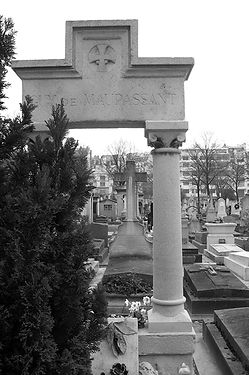
Cimetière du Montparnasse
The cemetery was created at the beginning of the 19th century in the southern part of the city. At the same time there were cemeteries outside the city limits: Passy Cemetery to the west, Montmartre Cemetery to the north, and Père Lachaise Cemetery to the east.
In the 16th century the intersecting roads of Vavin and Raspail were dump areas for rubble and stones from nearby quarries. This created an artificial hill and is where "mont" came into the name Montparnasse. Students at the time would congregate on the hill to participate in open-air dances.
During the French Revolution the land and church were confiscated and the cemetery became property of the government. At this time, anyone who died at the hospital and whose body was not claimed was buried here.
Famous Graves
Jean-Paul Sartre https://en.wikipedia.org/wiki/Jean-Paul_Sartre
Simone de Beauvoir https://en.wikipedia.org/wiki/Simone_de_Beauvoir
Charles Baudelaire https://en.wikipedia.org/wiki/Charles_Baudelaire
Guy de Maupassant https://en.wikipedia.org/wiki/Guy_de_Maupassant

Lone Fir Cemetery
The original land owner, James B. Stephens, purchased a land claim extending from the east bank of the Willamette River to present day Southeast 23rd and from Stark Street to Division Street. J. B. Stephens' father Emmor Stephens died shortly after the Stephens family arrived to Oregon in 1846 and was buried on the family farm. In 1854, Stephens sold the land to Colburn Barrell, with the caveat that he maintain Emmor's gravesite. Barrell owned a steamboat the Gazelle, which in 1854 exploded near Oregon City, killing a passenger and Barrell's business partner Crawford Dobbins. Barrel then set up a cemetery by setting aside 10 acres (40,000 m2) and burying the casualties of the explosion at the site of Emmor Stephens, calling it Mt. Crawford.
Famous Graves

Cimetière du Père Lachaise
The cemetery of Père Lachaise opened in 1804 and takes its name from the confessor to Louis XIV, Père François de la Chaise (1624–1709), who lived in the Jesuit house rebuilt during 1682 on the site of the chapel. The property, situated on the hillside from which the king watched skirmishing between the armies of the Condé and Turenne during the Fronde, was bought by the city in 1804. Established as a cemetery by Napoleon during that year, plans were laid out by Alexandre-Théodore Brongniart; the property was later extended. Napoleon, who had been proclaimed Emperor by the Senate three days earlier, had declared during the Consulate: "Every citizen has the right to be buried regardless of race or religion."